The 2026 Housing & Safety for All Plan, developed by the Nashville People’s Budget Coalition through direct engagement with thousands of directly impacted Nashville residents, is a $25 million plan — 0.5% of the total operating budget — to lay the foundations necessary to guarantee permanently affordable housing and genuine community safety for all Nashvillians.

Background
Building on our 2025 Housing & Safety for All campaign, developed through mass outreach across the city, we spent the last four months once again going directly to the people of Nashville to learn about their housing struggles, if they will be able to stay in Nashville without permanently affordable housing options, how permanently affordable housing would impact their lives and communities, and what kinds of non-police community safety would most improve life in their neighborhood.
From January to April of this year, we held more than 100 front-porch conversations, hosted 200 Nashvillians impacted by housing insecurity and lack of safety at two assemblies and one town hall, distributed more than 2,000 flyers in neighborhoods and at community events, and received more than 100 survey responses. All told, we directly engaged nearly 500 residents living in every council district.
The City Budget is the people’s money — but the people don’t get a say in how it’s spent. In the Nashville of our dreams, the Nashville we are organizing to build, all residents play an active role in shaping the budget and governing our communities. Our extensive community outreach and democratic deliberation at assemblies prefigures the future we are fighting for and clarifies the problems we face and the solutions we offer through our 2026 budget demands.
THE PROBLEM
We Can’t Afford to Stay & We Need Genuine Safety
Housing
A massive and rapidly growing number of Nashvillians can no longer afford to live in their own city.
Nearly half of all Nashvillians rent their housing, and more than half of all renters in Nashville are “cost-burdened,” meaning they spend more than 30% of their income on rent, and more than one in four Nashville renters are “severely cost-burdened,” spending more than 50% of their income on rent. Nashville’s unaffordability crisis impacts hundreds of thousands of residents across the city, but some experience it more severely than others: the city’s latest community needs evaluation report shows that poverty rates, housing insecurity, and life expectancy continue to hit Black Nashvillians harder than white residents.
According to a new Vanderbilt University poll, 82% of Nashville residents cannot afford to buy a home in Davidson County, and 73% of Nashville residents list affordable housing as their “top priority”.
Developers are building new housing all across Nashville, as they have for the last decade plus. The skyline is, and has been, full of cranes. The problem is that almost all of the housing being built is unattainable to those who need it most. Luxury units made up 93% of all new housing units between 2012 and 2022. Unsurprisingly, the National Community Reinvestment Coalition’s “Displaced By Design” report found that Nashville experienced the most “intense” gentrification of any U.S. city between 2010-2020. Homelessness, evictions, and housing costs in Nashville are on the rise while thousands of those same luxury units sit empty and hundreds of parcels of Metro-owned land sit unused or underused.
The rent is too damn high. All the new housing is for rich white people. Affordable housing is sparse and doesn’t stay affordable for long. This is what happens when we prioritize profit over people. This is what happens when we embrace the logic of racial capitalism and let the market determine the quality — and length — of people’s lives.
Mayor O’Connell currently invests less than 2% of the city’s massive $3.8 billion budget on affordable housing. Almost none of the affordable housing that the city funds is guaranteed to remain affordable permanently.
Before his election in 2023, Mayor O’Connell looked us all in the eye and told us: “I want you to stay.” We want to stay, too. But we can’t stay without unprecedented investment in permanently affordable social housing, as opposed to temporarily affordable housing. It’s not enough to “want” us to stay. We need investments that guarantee it. This is a matter of life and death. We need Mayor O’Connell and other city leaders to act like it.
Safety
The same Vanderbilt poll cited above found that 63% of residents want to see an increase in safety resources that actually “reduce crime.” This comes after years of major annual increases in spending on police, courts, jails, and surveillance, annual investments that have continued to balloon as official crime rates have both risen and fallen.
A majority of the thousands of residents we have engaged over the last half decade have been crystal clear that our current reactionary, police-centered system of “public safety” and surveillance is not meeting most residents’ needs, and is in fact making things worse. Thousands of the Nashvillians we have engaged want meaningful public investment into resources that produce genuine safety without resorting to police, courts, or jails.
And yet, the city invests nearly $1 billion annually into cops, courts, and cages — more than 20% of the total city budget and nearly half of the General Fund — but only $5 million annually (0.1% of the entire operating budget) into highly effective non-police forms of community safety. The incomprehensible amount of money dedicated to MNPD goes to policing practices that are overwhelmingly focused on reacting after minor calls for service and subsequently deliver little if any tangible safety outcome. Unhoused, working class, Black, and Brown Nashvillians remain the primary targets of police activity, and the Community Review Board continues to field a significant amount of complaints about officer misconduct in the community.
Meanwhile, as of mid-March, MNPD continues to hold approximately $15 million in public dollars — our money — for 138 unfilled police officer positions. For years, mayors and police chiefs have promised that each new year is the year they will finally fill all positions we have already paid them for. When will our city leaders finally wake up and recognize that maintaining massive investment into policing practices that do not create the safety we deserve robs us of the opportunity to use our money to produce genuine safety rooted in prevention and trauma-informed response.
THE SOLUTIONS
Social Housing & Non-Police Community Safety
According to this year’s Vanderbilt poll and years of public testimony and outcry, permanently affordable housing and genuine community safety are Nashville residents’ top priorities. Mayor O’Connell says they are his as well: at his weekly media roundtable on January 9, 2026, Mayor O’Connell told the press: “I am personally committed to safety and affordability as our top priorities.”
Is the mayor’s “commitment” to genuine safety and deep affordability merely a stated intention, or is it a budget allocation? This is the only thing that matters. If Mayor O’Connell is truly committed to genuine safety and real affordability, then fully delivering on our demands, which emerge from deep engagement with thousands of Nashvillians struggling to survive and thrive in their own city, is the easiest way to prove his integrity. Doing so will also almost certainly increase his approval ratings that have plummeted over the last year.
1. Social Housing Fund: $10 million
In 2025, we advocated for $500,000 for staff to establish and run a Social Housing Fund. Social housing is high-quality, permanently affordable, publicly-owned, bond-financed, mixed-income, community-governed, environmentally sustainable housing. Cities like Atlanta, Chicago, Seattle, and Chattanooga are joining cities around the world in embracing an approach to housing that meets people’s needs and pays for itself over time and generates more housing more quickly without depending on federal funds that are quickly disappearing. Nashville has a chance to become a leader in social housing by sustainably addressing the urgent affordability crisis in our city.
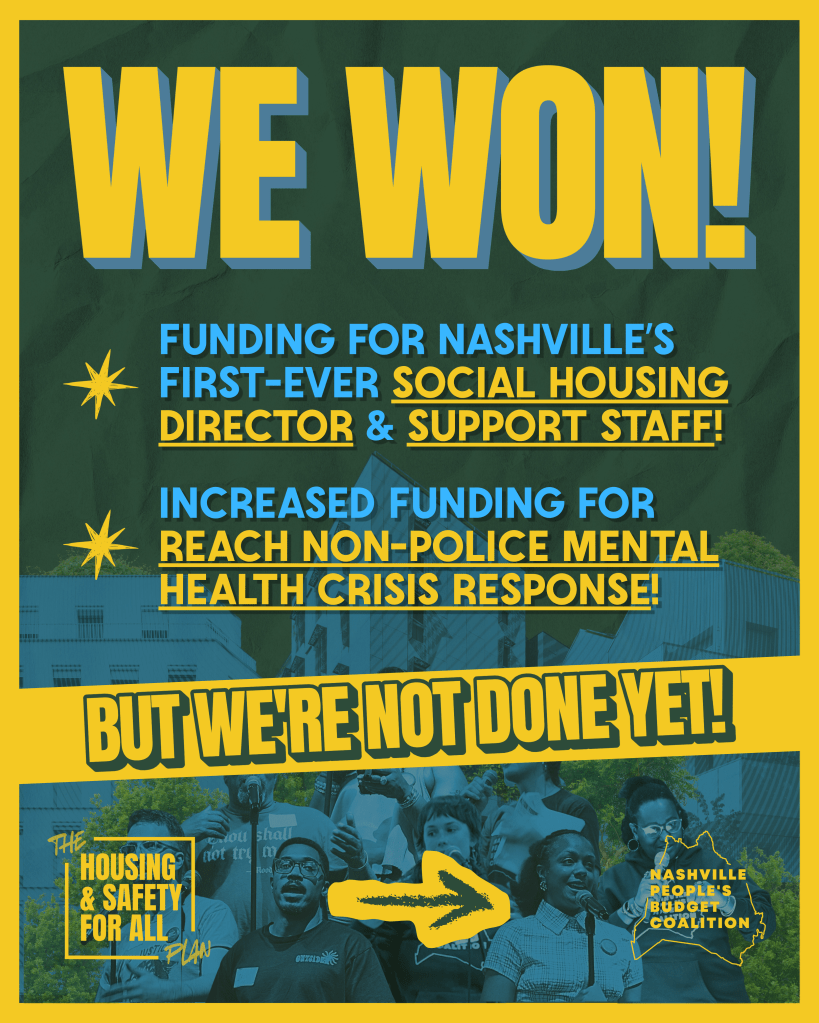
Instead of actual social housing, we got a “study.” While we counted this as a win that we could use to build momentum, Metro has been largely unresponsive to our questions and only recently initiated the study, ignoring our recommendation to hire the premier social housing expert consultants in the U.S. in favor of another consultant. In light of the urgency of the crisis Nashvillians face, Metro’s overall unresponsiveness and slow-walking is deeply unacceptable.
This year, as the city approaches the Fiscal Year 2027 operating budget, we renew our demand for approximately $500,000 for three staff to establish and operate the Nashville Social Housing Fund, because the specialized, devoted positions required to fulfill this work successfully do not yet exist within Metro Government. As detailed in our full social housing proposal, the Fund would be governed by a board composed of renters, people with lived experience of housing insecurity or homelessness, social housing policy experts, grassroots affordable housing advocates, affordable housing developers, and public interest finance professionals.
Catalyzed by the thousands of Nashville residents who keep telling us they need housing that allows them to stay in Nashville, we are also expanding our demand to include an additional $9.5 million to dedicate for 3-5 years of debt service payments on $50-100 million in bonds that we urge the city to issue over the next year. While debt service is paid after bonds are issued, the urgency of our crisis demands a guarantee now that the funds will be available for future debt service payments to create and maintain permanently affordable social housing in Nashville. Setting aside those funds now will free up space in the budget in years ahead without sacrificing funding for housing.
2. Community Safety Fund: $13 million
While Mayor O’Connell has pushed for increased policing and surveillance technology, he also recently stated that “there is more to safety than policing.” Following our 2025 demand for a citywide community safety plan, the mayor recently appointed a task force — largely composed of department heads and nonprofit Executive Directors — to create recommendations for a community safety plan based in violence prevention.
We have been clear that this task force, which co-opted and neutralized our demands for a Community Safety Plan that we made last year, will not accomplish anything meaningful without the presence of expert practitioners who have been excluded from the process, and without centering residents impacted by criminalization and lack of safety.
Nevertheless, Mayor O’Connell has the opportunity right now to deliver on the task force’s stated goal of building a “healthier, safer community where everyone has the resources they need to thrive” by reversing course and moving significant funds to non-police community safety instead of more policing.
Traditional “public safety” approaches react after harm has already taken place with a one-size-fits-all approach: a badge, a gun, the authorized use of force, the threat of violence and captivity, and surveillance. Community safety, in contrast, prevents harm at the root and responds to harm according to context and need. The disparity in spending between these two approaches — nearly $1 billion for public safety and $5 million for community safety — will not begin to change without unprecedented investment into non-police alternatives.
To that end, we call on Mayor O’Connell to devote $15 million to resource non-police community safety in the FY27 operating budget, separated into two separate allocations.
To that end, we call on Mayor O’Connell to allocate $13 million for the Community Safety Fund, currently funded at $3 million annually and facilitated by the Metro Public Health Department, which makes grants to community organizations engaged in violence prevention work and other forms of community safety fully outside Metro Nashville government. This money should come with a formal, codified guarantee that these funds will never be routed to police, courts, or jails, or to organizations that programmatically support the work of police, courts, or jails.
Many existing and nascent grassroots community organizations have the skills, relationships, and expertise to create genuine safety beyond policing. What they don’t have is the resources to grow and sustain their work. Community organizations already doing community-based safety work or who have the skills but not the resources to do so need no-strings funding and, when necessary, support in completing applications and providing information needed to receive funds.
The distribution of Community Safety Fund grants is currently determined by a Metro Public Health Department committee. In addition to a $13 million allocation to the Fund, we call for a restructuring of the process by which its grants are made. Specifically, we call for the creation of a new committee with the power to select grant recipients composed as follows: one-third people with lived experience of community violence or criminalization, one-third non-police community safety practitioners, and one-third Metro Public Health Department staff.
3. REACH PROGRAM EXPANSION: $2 million
In addition to $13 million for the Community Safety Fund to fund non-police community safety, we call for $2 million to be allocated to the REACH non-police mental health crisis response program, facilitated by Metro Fire/EMS and Mental Health Co-Op, in order to allow it to expand its 24/7 programming and thereby expand its impact. The REACH program, together with the Office of Youth Safety, are the only Metro-operated community safety programs that function separately from the criminal justice system.
CONCLUSION
This platform is the result of years of grassroots participatory democracy and community engagement centered around the idea that residents should have a more direct say in how their tax dollars are spent, and that the first priority of a city budget should be to fully meet residents’ needs.
This platform calls for a truly minuscule amount of money — $25 million, 0.5% of the total operating budget — to be invested to lay the groundwork for permanently affordable housing and genuine community safety for all Nashvillians. The demands correspond precisely with the stated commitments of city leaders and directly address community needs identified by city researchers.
At the end of the day, while we call for these items to be funded, we also call for a full democratization of budgeting and governance in our city. To that end, when these items are funded, community organizations and impacted community members must be centrally included in the process of bringing the vision articulated here to life.